
AFJ career field guide · United States
How to Become a Wildfire Helicopter Pilot
The hours can get your application considered. The aircraft, utility skills and fire experience determine which seat makes sense.
If you already fly helicopters, start by separating what you lack: command hours, experience in the target aircraft, external-load skills, or fire experience. A new rating, a longline course and a season as SIC solve different problems. This guide uses employer requirements to help you choose the next useful move.
Employer requirements reviewed November 3, 2026.
01 / Choose the entry route
SIC, PIC trainee and PIC are different starting points
SIC: enter the crew
A second-in-command role can put you alongside a fire crew before you are ready to command the aircraft. Some postings accept much lower hours than PIC jobs. Others require hundreds of hours in a particular aircraft before you arrive.
The useful question is whether the actual seat fits your aircraft background and provides the mission exposure you need. A low minimum alone does not establish the assignment, training or flight time.
PIC trainee: bring the foundation
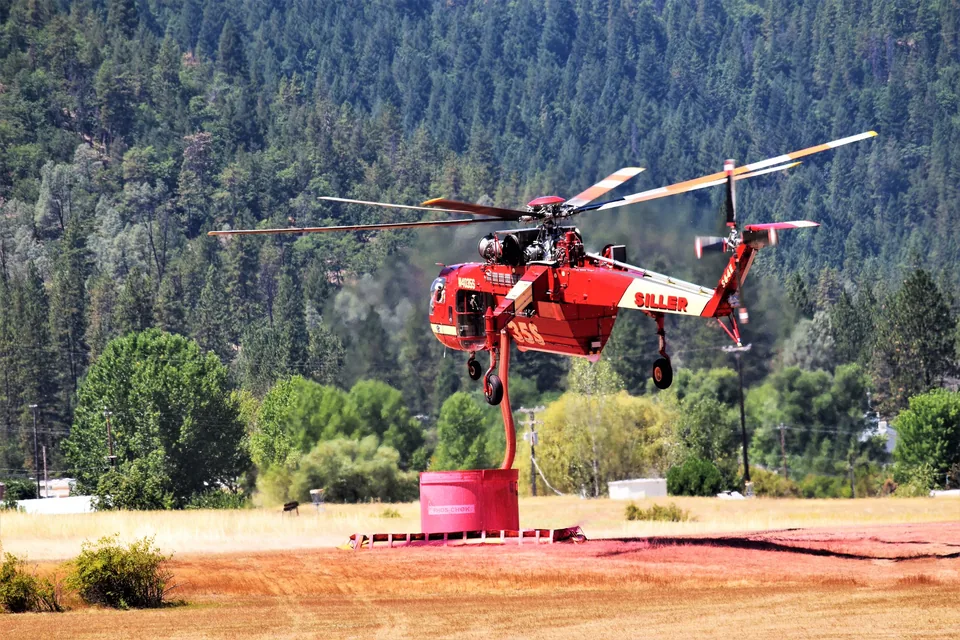
“Trainee” can mean learning a new aircraft, rather than learning utility flying from scratch. Helicopter Express’s S-64 trainee description still calls for precision longline skills and the applicable USFS hour requirements, with an exception for S-64-specific time.
If your main gap is external-load experience, do not treat that title as evidence the employer will teach the whole job from zero.
Direct PIC: demonstrate the mission as well as the hours
This route is strongest when you can document the target aircraft experience and the kind of work the operator performs. Utility, construction and fire assignments can overlap, but their individual requirements still matter. An experienced EMS pilot and an experienced utility pilot may have similar total time and very different gaps.
02 / Compare the market
What helicopter employers actually ask for
These are selected employer descriptions retrieved November 3, 2026. They are examples to plan against, not universal minimums or a promise that a seat remains available. Company links open employer profiles or careers pages rather than old individual vacancies. Use the live openings section for current jobs.
| Employer and seat | Published requirements or preferences | Practical meaning |
|---|---|---|
| Capitol SIC Pilot | Minimum 500 rotorcraft/helicopter hours; FAA commercial or ATP; first- or second-class medical. Prior UH-60 PIC/SIC experience is preferred. | A lower hour floor, with a separate aircraft preference. The SIC description alone does not promise a fire assignment or a particular amount of flying. |
| Helicopter Express S-64 SIC | Commercial helicopter certificate and second-class medical. Prefers 800–1,200 rotorcraft PIC hours; also lists previous turbine time and a valid U.S. passport. | The preferred range is PIC time, not total time. Keep that distinction visible in your application. |
| PJ Helicopters CH-47 SIC | 500 turbine-helicopter hours and 500 CH-47D/F (BV-234) hours. Civilian certificate/type-rating or stated military-qualification route; first- or second-class medical. | Call-when-needed and aircraft-specific. “SIC” here does not mean a general entry job for a pilot without CH-47 experience. |
| Capitol Pilot: construction and fire | 2,500 helicopter PIC, 500 turbine PIC, and 100 PIC in at least one named aircraft. More than 100 hours vertical reference, HEC/short haul and USFS carding are among preferences. | Meet each required time category separately. Preferred vertical-reference experience should not be rewritten as a universal hiring minimum. |
| Helicopter Express S-64 PIC trainee | Commercial helicopter certificate, second-class medical and precision longline skills. Must meet the stated USFS hour requirements except S-64-specific time; S-64 or Type 1 experience is preferred. | The aircraft-time allowance is specific. It does not waive command-hour or longline expectations. |
For Capitol’s PIC example, the named aircraft are Bell 407, 429, 212S/205, 412 and UH-60. Having 100 PIC hours in an unrelated helicopter is not the same requirement. Helicopter Express’s experienced S-64 PIC description separately asks for S-64 type-rating/experience and describes vertical reference, construction, longline, aft-seat and firefighting work.
Build a logbook summary with separate lines for helicopter total, helicopter PIC, turbine PIC, target aircraft PIC/SIC, external-load and relevant mission experience. Do not add overlapping categories together as if they were separate hours.
03 / Use your background
Coming from EMS or the military
EMS: keep the useful experience and name the missing skill
You may already bring turbine time, sound judgment, crew communication and experience working away from a main base. If your target is a utility/fire PIC seat, those strengths do not by themselves demonstrate precision external-load work. Longlining and vertical reference are related skills: the load is below the aircraft, and the pilot uses a different outside visual reference to control its placement.
An introductory course can help you begin that skill. Paid utility work can build evidence of doing it in an operational setting. An SIC role may build fire familiarity. Choose according to the gap, rather than spending money on another qualification that the target posting does not ask for.
Military: match the exact airframe and qualification route
The PJ example explicitly recognizes current CH-47D/F military qualification as an alternative to its stated civilian certificate/type-rating route. It still specifies the aircraft and turbine-hour requirements. A military background in another aircraft is valuable, but it does not satisfy those CH-47 categories automatically.
Show your actual command time and airframe experience clearly. Separate civilian certificate and medical requirements from the mission experience needed by the employer. A military applicant with the right aircraft background may have a very different route from one who needs both a new type and civilian utility experience.
Build the experience the target seat actually needs
- If the gap is total or PIC time: choose work that adds the required category. A job that adds mostly SIC time cannot be assumed to close a helicopter PIC requirement.
- If the gap is aircraft experience: compare jobs that require it before hire with trainee programs that explicitly provide it. Helicopter Express’s S-64 allowance is one concrete example of the latter, with other prerequisites still in place.
- If the gap is external-load skill: investigate structured training and utility work. Volo Mission’s longline course describes vertical-reference foundations, line control and progressively more precise work. Course completion is training evidence, not the same thing as a record of operational work.
- If the gap is fire experience: look for a crew position that provides supervised learning and a clear training process. An operator’s fleet and fire contracts alone do not establish what your own assignment will be.
Example: plenty of total time, one specific shortage
Suppose you have 3,000 helicopter hours, including 2,200 PIC, 600 turbine PIC and 150 PIC in a Bell 407. For Capitol’s stated PIC minimums, the shortage is 300 helicopter PIC hours. More turbine time, an external-load course or a season credited only as SIC would not automatically close that particular gap. Assess the preferred mission experience separately.
This is an illustrative logbook comparison, not an employer hiring decision.
04 / Plan beyond the first season
An SIC season can teach fire without solving your hour gap
A fire assignment includes days preparing, waiting, repositioning and supporting the crew as well as flying. A season on the roster is not a fixed number of loggable hours. Before treating an SIC job as a route to command, compare the flight time you can actually log with the categories required for the next seat.
Keep a simple progression record: starting PIC and SIC totals, training completed, mission experience gained and the remaining requirements for two target PIC roles. Review what changed after a season. If the remaining obstacle is PIC hours, building time in tours, EMS or other qualified flying work and later returning to fire may be one practical route. It is a possibility, not a guaranteed promotion sequence.
Mentorship matters as much as the title. Look for a captain who explains decisions and an operator that provides structured training, briefings and feedback. Being nearby when work happens is less useful than understanding the mission and receiving supervised opportunities to develop. Employment as SIC does not by itself establish how every flight may be entered in your logbook.
AerialFire’s career overview emphasizes understanding the suppression mission and working as part of a larger team. That is a useful first-season learning goal alongside aircraft proficiency: understand how your crew’s work supports the people on the ground.
Make the application—and the annual budget—concrete
Start your resume with the time categories the operator lists. Follow with relevant aircraft, actual external-load or utility experience, fire assignments, current certificates/medical and availability. Label training as training. Give references who can speak to your judgment and work, rather than relying on a recognizable company name to explain your experience.
The PJ posting provides a useful pay example: it lists an anticipated $32–$36 an hour for that on-call SIC role, depending on experience and qualifications. It does not establish guaranteed annual hours or annual earnings. Multiplying that range by 2,080 would assume a full paid work year that the posting does not promise.
Compare guaranteed paid days or hours, standby terms, travel, housing, benefits, training costs and the length of the assignment with the job you would leave. Seasonal winter work can help a transition budget, but count it only when you have a workable arrangement. A lower first-season income can be a deliberate choice; make it part of the plan rather than discovering it after accepting.
Use the helicopter jobs page to identify roles, then research the operator. Preserve the posting you applied to and its date so your hour comparison stays tied to that opening.
If you are starting with little or no helicopter time
Your next objective is professional employability, not an immediate fire PIC seat. Work through certificates, medical eligibility, training costs and initial flying work using the FAA’s pilot resources and a qualified instructor. A private certificate alone is not a professional firefighting qualification.
Study the examples early. The difference between Capitol’s 500-hour SIC posting and PJ’s 500-hour CH-47 requirement shows why “get to 500 hours” is not a complete career plan. Choose early work for the category of time and experience it actually builds. Avoid buying advanced mission training solely because it sounds like a shortcut to a fire job.
Sources and scope
Prepared by Aerial Firefighting Jobs. Employer pages and public recruiting descriptions reviewed November 3, 2026: Capitol SIC, Capitol Pilot, Helicopter Express, and PJ CH-47 SIC. Capitol details were read through its public ADP endpoints; PJ’s description was read through its public embedded recruiting page. Volo Mission supports the description of its course, not a hiring or agency-approval guarantee.
The table is a selected sample, not a survey of every operator. Employer preferences, certificate privileges, contract requirements and agency mission approval are different things. The examples explain career choices rather than teach operational flying procedures. Send a correction or share career context →
From the current job catalog
Current helicopter pilot openings
These listings refresh when you load the guide. They are separate from the dated requirements examples above. Confirm the employer’s current requirements before applying.
No recently confirmed matching openings are available to show here right now. Employers may still be hiring.